
How Do You Stay Compliant as Your Food Business Grows?
Staying compliant while scaling a food business requires keeping permits and licenses current, following food safety regulations, using an approved commercial kitchen when required, and maintaining accurate operational records. As production increases, food entrepreneurs must also verify that their facilities, food handling practices, storage procedures, and distribution methods meet applicable local and state health requirements.
Growing a food business is exciting, but expanding operations brings responsibilities that go beyond creating great food. Whether you’re increasing catering orders, launching a meal prep service, or moving from home-based production into a commercial kitchen, understanding regulatory requirements is essential to protecting your customers and your business.
At The Cookline, we understand the challenges food entrepreneurs face as they grow. Our shared commercial kitchen spaces in Carrollton and Plano, Texas, provide professional environments where culinary businesses can expand production without immediately investing in their own facilities. We believe entrepreneurs should be able to focus on creating exceptional food while building the operational foundation needed for sustainable growth.
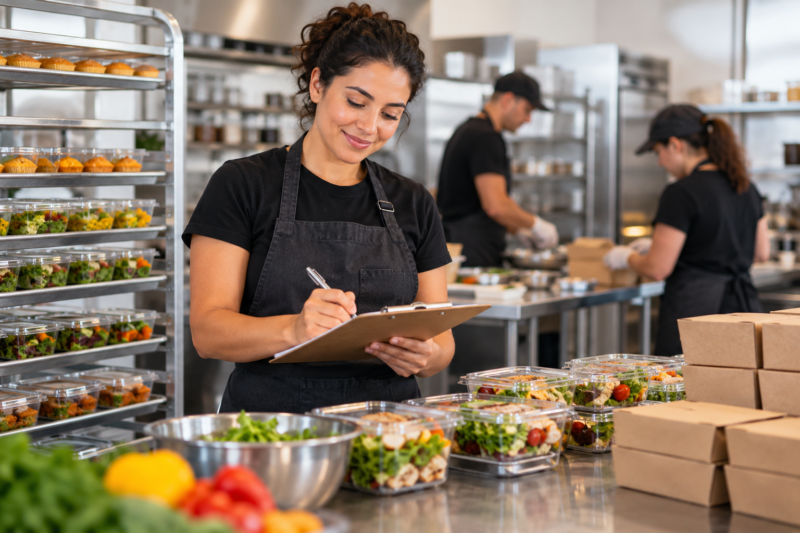
Food Business Compliance Requirements When Expanding Production
Scaling successfully means making sure your business operations grow alongside your food safety procedures, licensing requirements, and production capabilities.
1. What Permits and Licenses Do You Need to Expand a Food Business?
The permits required to expand a food business depend on what you produce, where you operate, and how your products reach customers.
A food entrepreneur who begins selling directly to consumers may face different regulatory requirements when expanding into wholesale distribution, catering, or packaged food production.
Common requirements may include:
- Food establishment permits: Often required for businesses preparing or selling regulated foods.
- Food manager certification: Certain operations must have a certified food protection manager.
- Food handler training: Employees may need approved training depending on applicable regulations.
- Sales tax permits: Businesses making taxable sales may need to register with the Texas Comptroller.
- Specialized food licenses: Certain products, manufacturing activities, and distribution models require additional approvals.
The Texas Department of State Health Services (DSHS) regulates many food-related activities, while municipal health departments may oversee retail food establishments within their jurisdictions.
Before expanding, contact the appropriate regulatory authority to confirm whether your existing permits cover your new activities. A permit for one business model does not automatically authorize every type of food production.
2. When Should You Move Into a Commercial Kitchen?
A commercial kitchen becomes necessary when your business activities exceed what is legally permitted under applicable home-food production rules or when your production needs require a regulated facility.
Texas cottage food laws allow qualifying foods to be prepared in home kitchens under specific conditions. However, not every food product or sales model qualifies.
For example, certain temperature-controlled foods, manufacturing activities, or distribution arrangements may require additional regulatory oversight. Business owners should verify current Texas cottage food rules rather than assume that increasing sales alone determines whether a commercial kitchen is required.
Moving into a shared commercial kitchen can provide several advantages:
- Access to professional food production space
- Separation between household activities and commercial operations
- Greater flexibility when increasing production volume
- A facility designed for regulated food preparation
- An alternative to leasing and outfitting a standalone restaurant
At The Cookline, our commercial kitchen rental options help food entrepreneurs transition toward larger-scale operations while maintaining flexibility.
Important: Renting a commercial kitchen does not automatically satisfy every licensing requirement. Each food business remains responsible for obtaining the approvals applicable to its products and activities.
3. How Can You Maintain Food Safety Standards as Production Increases?
Maintaining food safety standards during expansion requires documented procedures, trained employees, appropriate equipment, and consistent monitoring.
The U.S. Food and Drug Administration’s Food Code provides a widely used model for retail food safety regulations. Texas and local jurisdictions establish enforceable requirements through their adopted rules.
As your operation grows, prioritize these practices:
- Temperature control: Monitor cooking, cooling, refrigeration, and hot-holding temperatures according to applicable requirements.
- Cross-contamination prevention: Separate raw ingredients from ready-to-eat foods and follow appropriate cleaning procedures.
- Employee training: Make sure staff understand handwashing, food handling, and illness-reporting procedures.
- Sanitation documentation: Maintain cleaning schedules and records when required or useful for your operation.
- Ingredient tracking: Establish systems for identifying suppliers, product batches, and relevant expiration or use-by dates.
A process that works when preparing 20 orders may not be sufficient when producing 200.
Standardized recipes, written procedures, and regular internal reviews help maintain consistency as additional employees and larger production volumes enter the picture.
4. What Compliance Mistakes Should Growing Food Businesses Avoid?
One of the most common mistakes growing food businesses make is assuming their original permits, production methods, and operating procedures remain sufficient as the business changes.
Expansion can introduce new compliance obligations, particularly when adding products, changing sales channels, hiring employees, or moving into a new facility.
Watch for these potential problems:
- Operating beyond approved activities: Adding wholesale or manufacturing operations without checking whether new licenses are required.
- Inadequate food storage: Increasing inventory without sufficient approved storage capacity.
- Missing documentation: Failing to maintain required training, temperature, or production records.
- Incorrect labeling: Selling packaged products without reviewing applicable ingredient, allergen, and labeling requirements.
- Unapproved production locations: Preparing regulated foods in spaces not authorized for the intended activity.
According to the CDC, approximately 48 million people in the United States experience foodborne illness annually. This estimate highlights why consistent food safety practices matter, especially as businesses serve more customers.
Building compliance into everyday operations helps reduce avoidable risks while supporting long-term business growth.
5. How Does a Shared Commercial Kitchen Support Business Growth?
A shared commercial kitchen can help growing food businesses increase production capacity without taking on the full financial and operational commitment of a dedicated facility.
Rather than investing immediately in a private commercial property, entrepreneurs can explore kitchen rental arrangements that better match their current production needs.
For caterers, bakers, food truck operators, and meal prep businesses, this flexibility can make expansion more manageable.
A shared kitchen may also support more organized workflows by providing a professional setting for commercial food preparation.
However, entrepreneurs should confirm that a prospective facility is approved for their intended use and that their own permits, insurance, storage arrangements, and operating procedures meet applicable requirements.
The Cookline serves food entrepreneurs through its locations in Carrollton and Plano, TX. Our goal is to provide practical kitchen rental solutions that support growing culinary businesses at different stages of development.
Frequently Asked Questions About Food Business Compliance
Do I need a commercial kitchen to sell food in Texas?
Not always. Qualifying cottage food operations may prepare and sell certain foods from home under Texas law. Other activities require approved facilities and applicable permits.
Can I use a shared kitchen for a catering business?
Yes, provided the kitchen is approved for the intended catering activities and your business obtains any required permits. Confirm specific requirements with the relevant regulatory authority.
Do food business permits transfer when I change locations?
Not necessarily. Food establishment permits are often location-specific, and moving facilities may require a new application, inspection, or approval.
How often should I review my food business compliance requirements?
Review requirements whenever you introduce products, change facilities, hire staff, or expand distribution. Periodic reviews are also helpful because food regulations can change.
Ready to Scale Your Food Business With Confidence?
Growing your food business should be an opportunity, not an overwhelming process. With the right production environment, clear operating procedures, and an understanding of applicable regulations, you can prepare for expansion while protecting the business you’ve worked hard to build.
Explore commercial kitchen rental options with The Cookline in Carrollton and Plano, TX.
Contact us today to discuss your business needs and take the next step toward sustainable growth.