
How Do You Know When You’ve Outgrown Cooking from Home?
You’ve likely outgrown cooking from home when your kitchen limits how much you can produce, store, or sell efficiently, or when your business needs equipment, space, food-safety controls, or regulatory flexibility that a residential kitchen cannot provide. Common signs include turning down orders, running out of storage, struggling with production schedules, or needing a more professional setup to reach new customers.
At The Cookline, we understand that moving beyond a home kitchen is an exciting milestone, but it can also raise plenty of questions. Food entrepreneurs need room to grow without necessarily taking on the expense and long-term commitment of building or leasing a restaurant kitchen. A shared commercial kitchen can bridge that gap, giving caterers, bakers, meal-prep businesses, food product companies, private chefs, and other culinary entrepreneurs access to professional infrastructure when they need it. The goal is not simply to get a bigger kitchen. It is to create an environment where your business can operate more efficiently, maintain high standards, and pursue opportunities that may have been difficult to handle from home.
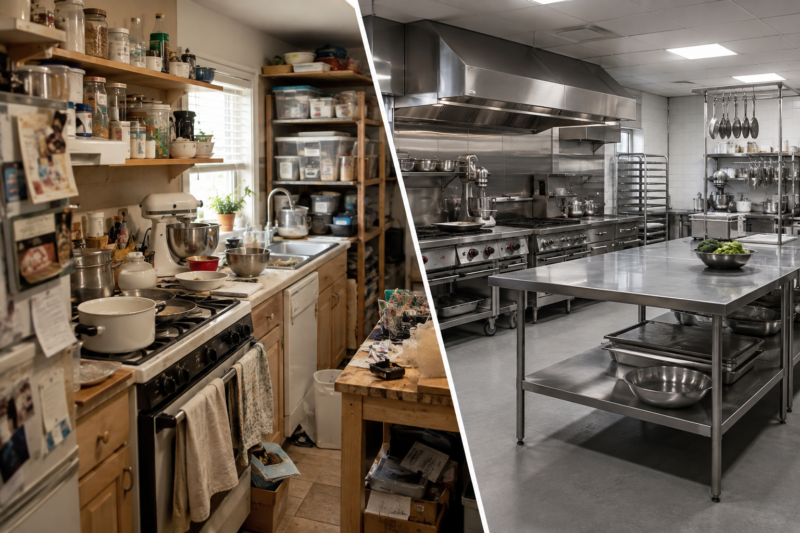
When Is It Time to Move from a Home Kitchen to a Commercial Kitchen?
The right time to move into a commercial kitchen is usually when your home setup starts determining how much business you can accept. Growth should be driven by customer demand and your business goals, not by how many sheet pans fit in your oven or how much product you can squeeze into the refrigerator.
Here are some of the clearest signs you may be ready.
1. Are You Turning Down Orders Because You Cannot Produce Enough?
Turning away profitable orders because of kitchen capacity is one of the strongest signs you have outgrown cooking from home.
A residential oven, refrigerator, counter, and sink are designed for household meals, not continuous commercial production. As orders increase, entrepreneurs often find themselves working extremely long hours simply because they cannot prepare enough products at once.
Warning signs include:
- Splitting one large order into multiple cooking or baking cycles
- Turning down catering jobs because you lack prep space
- Starting production unusually early or working late into the night
- Scheduling orders around your family’s use of the kitchen
- Consistently selling out because you cannot increase production
Commercial equipment and larger workspaces can help you produce more during the same amount of time. Instead of extending your workday, you can focus on increasing the output of each production session.
That efficiency becomes increasingly important as your business grows.
2. Is Food and Equipment Taking Over Your Home?
When business inventory begins consuming household storage and living space, your home kitchen may no longer be practical.
Growing food businesses need space for ingredients, packaging, finished products, cookware, small appliances, serving equipment, and cleaning supplies. What begins as one pantry shelf can quickly expand into closets, garages, dining rooms, and extra refrigerators.
Ask yourself:
- Are business ingredients competing with household groceries?
- Are boxes of packaging stacked throughout your home?
- Do you need additional refrigeration or freezer capacity?
- Are countertops permanently occupied by business equipment?
- Are family members constantly working around your production schedule?
These problems are more than inconveniences. Poor organization can slow production, complicate inventory management, and make maintaining consistent sanitation procedures harder.
Moving production into a commercial environment helps separate your business operations from your personal living space.
3. Have You Reached the Limits of What You Can Legally Produce at Home?
A growing food business should review its legal requirements before expanding products, production methods, or sales channels.
Rules for home-based food businesses vary by state and locality. The U.S. Small Business Administration notes that licenses and permits depend on both the type of business activity and its location, with requirements potentially coming from state, county, and city authorities.
Food entrepreneurs should also understand that cottage food rules are not the same everywhere. For example, Texas significantly expanded its cottage food framework beginning September 1, 2025. According to the Texas Department of State Health Services, the updated law increased the annual gross-income threshold for a cottage food production operation to $150,000 and expanded the types of foods that can qualify, while maintaining restrictions and additional requirements for certain products and time-and-temperature-controlled foods.
The FDA Food Code also provides science-based food-safety recommendations for retail and foodservice operations and distinguishes commercial food-establishment operations from typical private-home food preparation.
Before assuming you must move, check the rules that apply specifically to your products and sales model. Even when home production remains legal, however, a commercial kitchen can become the better operational choice long before you reach a legal limit.
4. Is Your Home Kitchen Making Production Less Efficient?
If every order requires rearranging equipment, clearing household items, or repeating small batches, your kitchen may be costing your business valuable time.
Efficiency matters because labor is one of the resources food entrepreneurs have to manage most carefully.
Consider a baker who can bake only a few trays at once. A catering company may have enough demand for a large event but not enough refrigeration to prepare efficiently in advance. A meal-prep company might spend hours rotating products through limited counter and cooking space.
A commercial kitchen can provide access to features such as:
- Larger preparation surfaces
- Commercial ovens and cooking equipment
- More refrigeration and freezer capacity
- Dedicated washing and sanitation areas
- Space designed around food-production workflows
The benefit is not simply having more square footage. A better workflow can help you produce more consistently and spend less time adapting a residential space to commercial tasks.
5. Are Bigger Business Opportunities Becoming Harder to Pursue?
If your production setup prevents you from pursuing larger orders, new sales channels, or wholesale opportunities, your kitchen has become a growth bottleneck.
A successful home-based food business may eventually attract inquiries from corporate clients, event planners, retailers, recurring meal-prep customers, or other organizations.
Those opportunities can require significantly more production capacity and operational consistency.
The U.S. Small Business Administration recommends that businesses preparing to expand confirm they are financially prepared and ensure they comply with applicable laws, rules, and regulations. For food entrepreneurs, production infrastructure should be part of that planning.
A shared commercial kitchen can offer an intermediate step between cooking at home and taking on the cost of a dedicated restaurant or production facility. You gain access to professional space while keeping your business more flexible as you determine how quickly demand will grow.
What Should You Do After Outgrowing Your Home Kitchen?
Start by identifying the specific constraint preventing your business from growing. Knowing whether your biggest problem is equipment, refrigeration, storage, production time, compliance, or overall capacity will help you choose the right next step.
Before moving your operation, consider:
- Calculate your current capacity. Determine how many orders or units you can realistically produce each week.
- Track lost opportunities. Record orders you decline because of space or equipment limitations.
- Identify equipment needs. List the appliances, prep areas, refrigeration, and storage that would make production faster.
- Review applicable regulations. Confirm requirements for your products, business model, and sales channels.
- Compare expansion options. Consider the costs and flexibility of shared commercial kitchen space versus leasing or building a dedicated facility.
A move should solve real business problems, not simply give you a larger room in which to work.
Frequently Asked Questions About Outgrowing a Home Kitchen
When should I move my food business out of my home?
Consider moving when your home kitchen limits production, storage, efficiency, food-safety processes, or your ability to accept profitable opportunities. You do not necessarily need to wait until home production becomes legally unavailable.
Do I need my own restaurant kitchen to grow a food business?
No. A shared commercial kitchen can give food entrepreneurs access to professional cooking and production space without requiring them to open a restaurant or immediately commit to their own full commercial facility.
Can a commercial kitchen help me produce more food?
Yes. Commercial equipment, larger preparation areas, additional refrigeration, and workflows designed for food production can allow businesses to complete larger batches and orders more efficiently.
What should I look for in a shared commercial kitchen?
Look for equipment that matches your production needs, sufficient prep and storage space, convenient access, strong sanitation practices, flexible usage options, and a setup that supports your business as order volume increases.
Ready to Give Your Food Business Room to Grow?
Outgrowing your home kitchen is a good problem to have. It means the operation you started at home may be ready for its next stage.
The Cookline gives growing food entrepreneurs access to professional commercial kitchen space without requiring them to take on the commitment of building an entire kitchen of their own.
Ready to move beyond your home kitchen? Contact The Cookline today to explore commercial kitchen space designed to help your food business grow.